A lash artist’s service menu can quickly grow to include full sets, infills and lash lifts. Pricing them is harder: how much should you charge for lash extensions and still make a profit without deterring clients? Copying a competitor’s price is not enough. Your rate must cover consumables, long periods of concentrated work, fixed costs and your pay.
The short answer: time real appointments, calculate a minimum profitable price with the formula below, then build infill prices from that figure. Set a clear maximum interval after which an infill becomes a new full set.
Why lash extensions are often underpriced
A full set requires a long, uninterrupted working period. Beyond application time, include welcoming the client, removing make-up, preparation, before-and-after photographs, aftercare advice, cleaning and disinfecting the station. A “two-hour set” can easily occupy two and a half hours of the day.
Consumables are another trap. Individual items look inexpensive, but lashes, adhesive, patches, primer, tape, micro brushes, spoolies, applicators and disinfectant add up. Open adhesive also has a working life that bears little relation to the theoretical number of sets in the bottle.
To find the true duration, time at least five appointments of each type from the moment the client settles in until the station is clean. Use the median.
Formula for a minimum profitable price
Minimum price = consumables + share of overheads + total time × target hourly rate + contingency margin
The target hourly rate is not take-home pay. It must cover contributions, non-billable hours—messages, purchasing, Instagram content and accounts—leave, training and quieter periods. Use your real business structure and figures.
1. Consumables per set
List everything used and divide each product by a realistic number of uses. For adhesive, work from its life after opening and the number of sets you genuinely complete during that period, not the theoretical capacity of the bottle.
2. Share of fixed costs
Add monthly expenses: premises or a share of home costs, treatment bed, lamp, insurance, software, banking, accounting and training. Divide the total by a prudent number of real monthly appointments, not your maximum capacity.
3. Total time
Multiply the complete time used by your target hourly rate. Russian volume or mega-volume work deserves a significantly higher price than a classic set because it takes longer and requires additional technique.
Worked example for a full set
This example is illustrative:
- consumables: €9;
- share of fixed costs per appointment: €8;
- total time used: 2 hours 30 minutes;
- target business hourly rate: €30;
- contingency margin: €5.
The result is: 9 + 8 + (2.5 × 30) + 5 = €97.
This is not a price to copy. It is the amount required for these assumptions. If your result appears too high for your area, review duration, organisation, positioning or complementary services rather than simply lowering the price and working at a loss. Try your own figures in the free service price calculator.
How to price lash infills
Infills encourage repeat visits but also create the most questions. Three rules prevent unpleasant surprises.
Calculate each infill separately
Use the same formula with the real infill duration. A two-week and a three-week infill do not require the same amount of work, which is why many lash artists publish two or three tiers.
Set a maximum interval
Beyond a stated interval, or when too few extensions remain, an infill takes almost as much work as a full set. Write a clear rule, for example: “After four weeks, or where fewer than 40% of extensions remain, the full-set price applies.” Display it on the service menu and mention it when booking.
Reward consistency without weakening your base price
A client who returns every three weeks fills the calendar predictably. Instead of permanent discounts, use a beauty loyalty card so a reward follows several visits without lowering every service price.
Should you compare other lash artists’ prices?
Yes, after doing your own calculation. Compare genuinely similar professionals: the same town or neighbourhood, technique, experience and setting. Prices on booking platforms do not show the costs or profitability behind them.
If your minimum is above the local market, explain what supports it: product quality, hygiene, retention, advice or a complimentary 48-hour fix. If you are far below, you may be leaving money on the table.
Lash lifts and tinting follow the same logic
A lash lift takes less time and uses fewer products, but is repeated approximately every six to eight weeks depending on growth. Calculate its minimum price in the same way and think about the next visit: a client offered a date before leaving is more likely to return than one simply told to book again later.
The most expensive pricing mistakes
- Using an “ideal” duration instead of the true time including welcome and cleaning.
- Dividing overheads by maximum capacity, which assigns too little cost to each service.
- Accepting overdue appointments at the infill price, effectively providing a full set at a discount.
- Never reviewing prices, even as lashes, adhesive and rent increase.
- Ignoring no-shows: a missed full set may mean two and a half hours lost. An automatic SMS reminder helps reduce forgotten appointments.
Monitor profitability without another spreadsheet
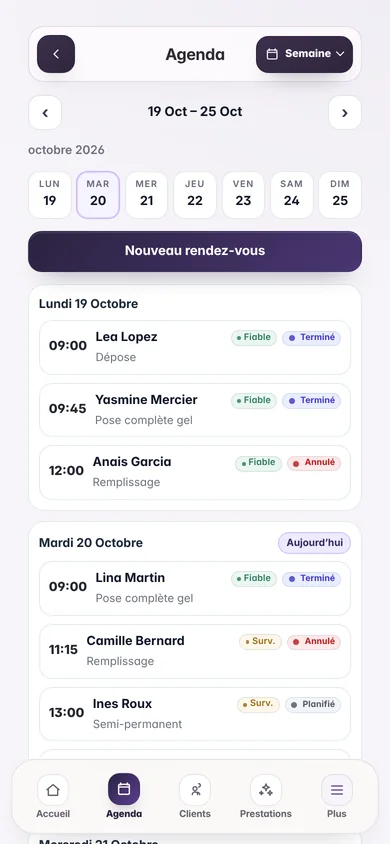
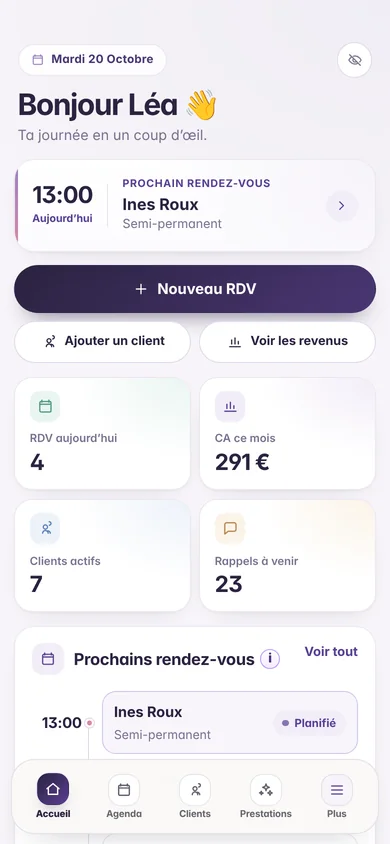
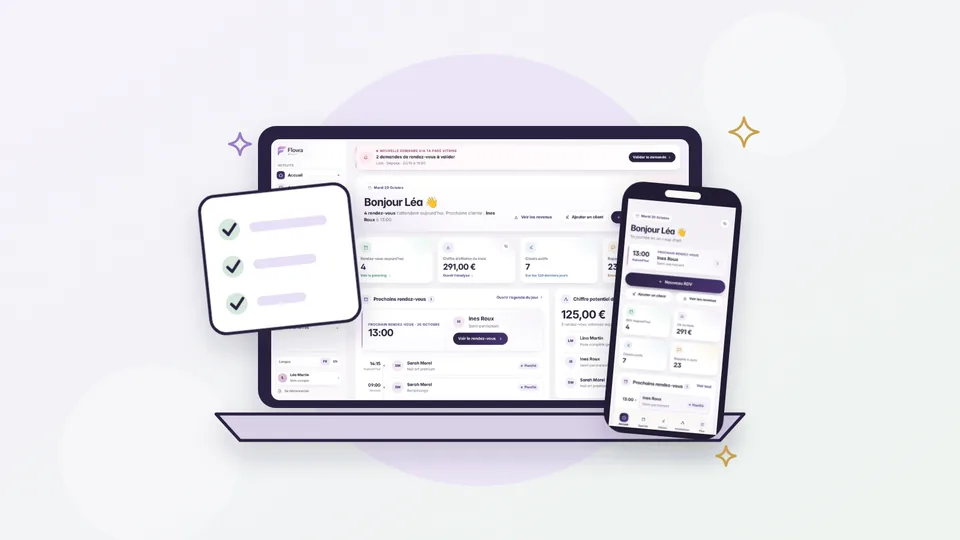
Once prices are set, check that they remain viable. In Flowa, every service has a duration and price, the calendar reserves the correct slot and the client record shows visit rhythm and average spend. You can quickly identify clients who return within the infill window and those who have gone beyond it.
See how Flowa supports lash and brow artists, or compare the essentials in our guide to choosing software for an independent beauty business.